The 2026 campaign cycle discovered a legal theory so elegant it deserves its own think tank: if the ad is fake, but funny, it doesn't count.
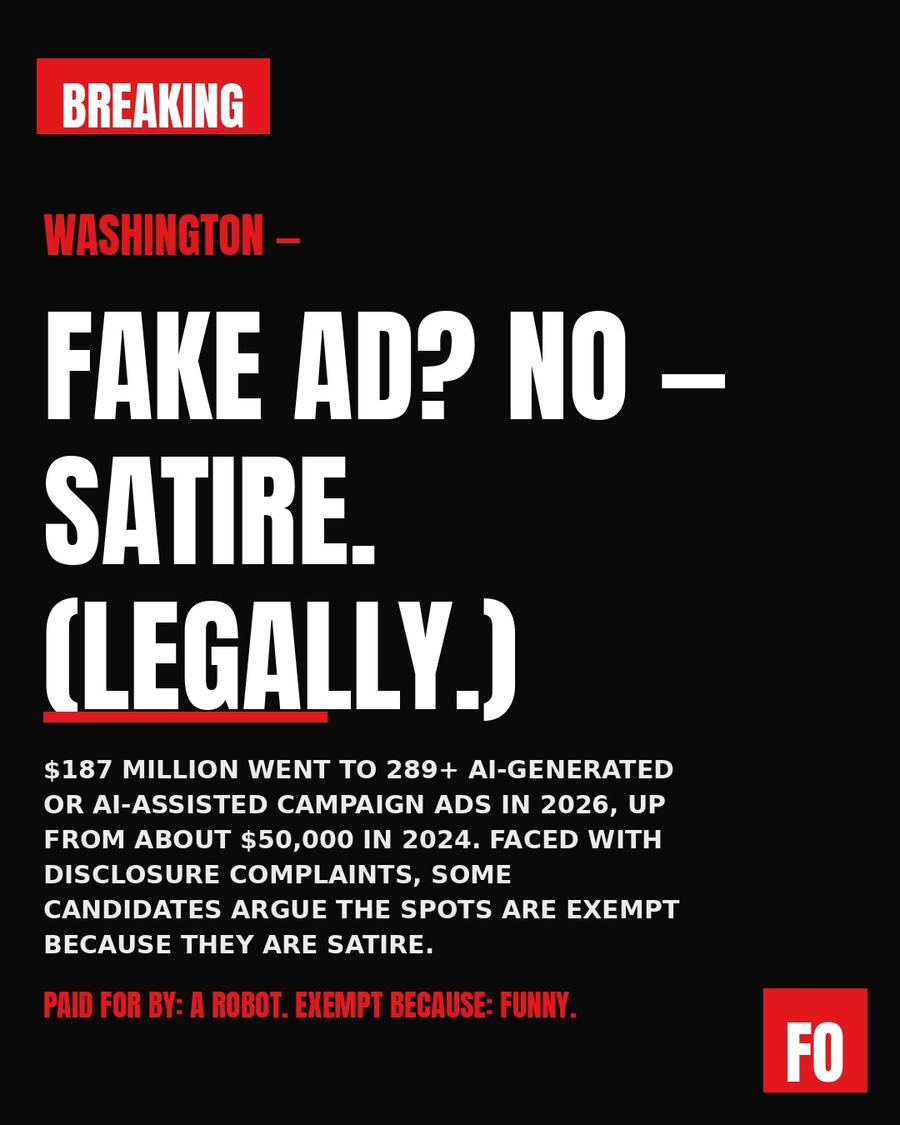
The Wesleyan Media Project, which tracks political advertising, identified more than $187 million in spending on at least 289 unique AI-generated or AI-assisted ads in 2026 as of October 29. Two years earlier, the same category barely existed: about $50,000 in 2024. In one cycle, the technology went from a curiosity to a line item bigger than most campaigns' entire media budgets.
The ads themselves are, by the researchers' own description, mostly obvious. A candidate marks up a Bible with a crayon. A governor gardens with a mayor in a pharmaceutical ad for a "political delusion pill." A Senate candidate grins from inside a Trojan horse draped with a banner reading "Definitely NOT Communism." None of these scenes occurred in real life, and none of them is trying very hard to convince you otherwise. Researchers have a name for the genre: slopaganda.
Here is where it gets legally interesting. Only about 27 percent of the AI ads counted through mid-October carried a disclaimer. When candidates face complaints about missing AI disclosures under state laws, some of them argue the spots are exempt because they are satire. The ad is not a deception, the argument goes, because it is a joke. The disclosure label, under this theory, would read: paid for by a robot, exempt because funny.
Like your satire sourced?
Get the Dispatch — the week's sharpest offenses, with receipts attached.
It is worth pausing on what that theory concedes. Nobody is arguing the ad is real. Nobody is arguing the voter was informed. The argument is that obvious fakery is its own disclosure, and that the law should treat a deepfake the way it treats a cartoon: protected, unserious, and nobody's problem. The counterargument writes itself: a cartoon never looked this much like footage, and footage never used to come with a laugh track.
The punch here is not aimed at any one candidate. Every campaign in America now has the same toy, and the toy's price fell from "experimental" to "cheaper than a focus group" in twenty-four months. The joke is the loophole: a disclosure regime built for television spots just met a technology that can generate a thousand television spots before lunch, and the first legal defense out of the gate is that none of it counts because it's hilarious.
It is, to be fair, hilarious. That is precisely why it needs a label.
The underlying reporting is filed in the Evidence Locker: USA TODAY (Oct. 30, 2026); Wesleyan Media Project (via USA TODAY).