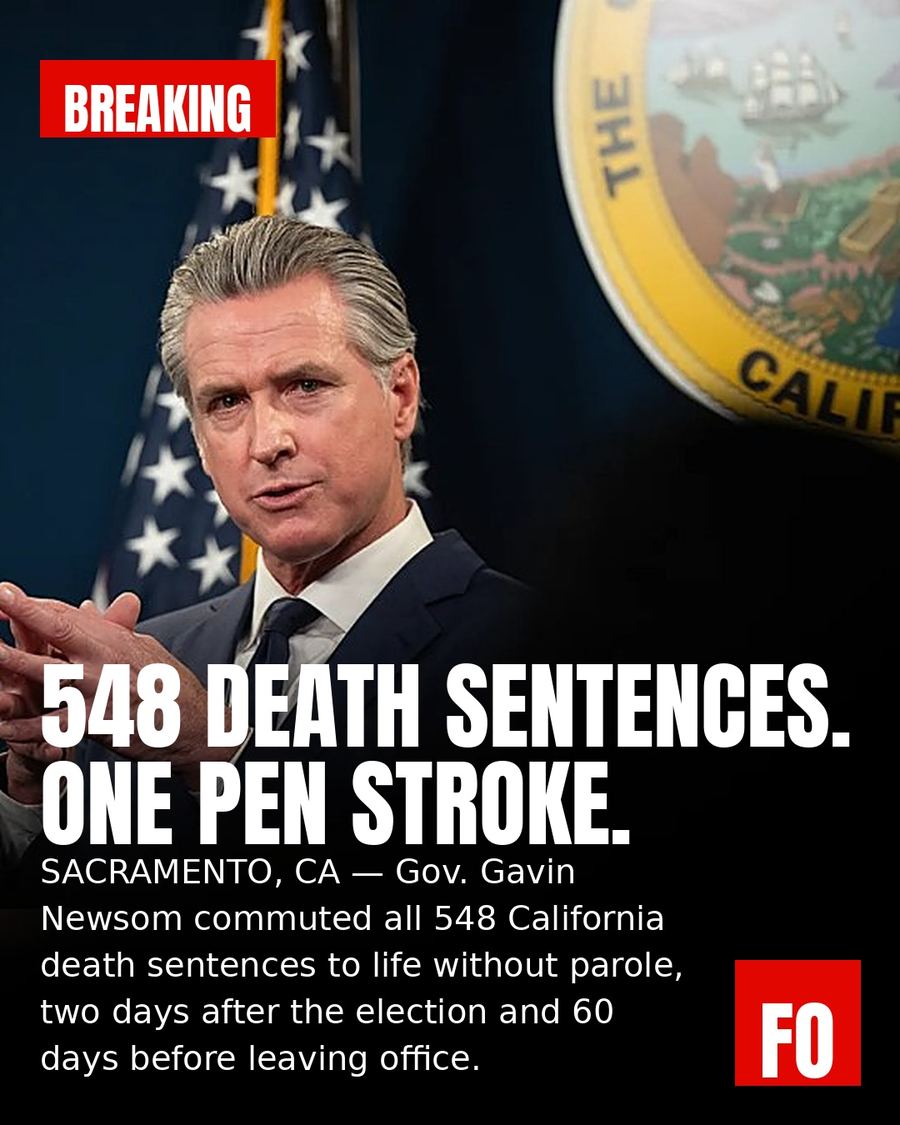
Gavin Newsom waited until two days after the election to empty death row. The timing is the story, and Newsom knows it, because everyone in California knows it. On November 5, with the votes counted and sixty days left in his governorship, he announced he is commuting all 548 California death sentences to life in prison without the possibility of parole. The largest mass clemency in American history, signed in the lame-duck window, after the last election he will ever have to win in California.
The substance is exactly what Newsom says it is. In an open letter, he called the death penalty unjust, error-prone, and incompatible with the state's values, and wrote that state-sanctioned killing diminishes each of us. He imposed a moratorium on executions shortly after taking office in 2019, and California has not executed anyone since 2006. The commutations do not repeal the death penalty, which California voters have twice refused to abolish. They apply only to the current sentences, and some of them still require review by the California Supreme Court. The governor's pen is powerful. It is not the only pen in the room.
The reaction split exactly the way a death penalty announcement always splits. Anti-death-penalty groups called it the height of moral leadership. District attorneys called it a profound disregard for juries, judges, victims, and the repeatedly expressed will of voters. One father whose son was murdered called Newsom a coward for doing it by blanket order instead of case by case, and said the governor's office never contacted his family before the announcement. The governor called the decision among the most difficult of his career, and said he deeply respects the views of those who will strongly disagree, including some families of victims who have suffered the worst possible loss. Everybody is telling the truth about how they feel. Nobody agrees about what it means.
Which brings us back to the calendar. Newsom is term-limited. Xavier Becerra takes over on January 4. A governor with eight years of convictions about the death penalty and sixty days left in office does not need to wonder when to act. He acts when the voters can no longer do anything about it, which is the one window in politics where a conscience and a schedule finally agree. The commutations are real, the convictions are long held, and the timing is doing a lot of the talking. The pen stroke took a second. The wait took two days past the election and seven years in office.
Like your satire sourced?
Get the Dispatch — the week's sharpest offenses, with receipts attached.
Sources: USA Today (Nov. 5, 2026).
The underlying reporting is filed in the Evidence Locker: USA Today (Nov. 5, 2026).